


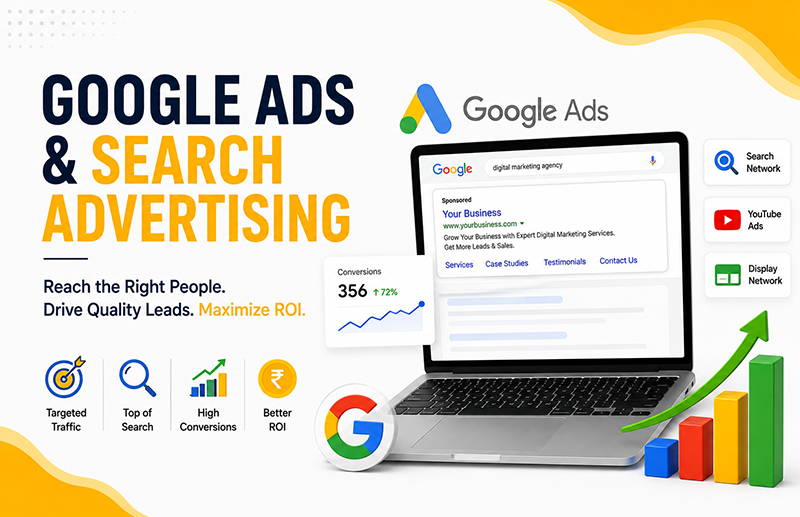
Google Ads & Search Advertising: Turn Searches Into Customers
When someone searches Google for a product or service, they are already telling you what they need.
They may be looking for a digital marketing agency, a dentist, a new phone, a hotel, a lawyer, a furniture store or a company that can solve a specific problem.
Google Ads allows businesses to appear in front of people at this important moment of intent.
But successful Google Ads is not simply about paying Google to show an advertisement. The real challenge is reaching the right searches, presenting the right offer, sending people to the right landing page and turning those clicks into actual business.
This guide explains how Google Ads works, when businesses should use it, what affects the cost, why campaigns sometimes fail, and how to measure whether your advertising is actually producing business results.
🔎 What Is Google Ads & Search Advertising?
Google Ads is Google’s advertising platform. With Search campaigns, businesses can show advertisements when people search for products, services or information related to what they offer.
The biggest advantage of Search Advertising is intent. Instead of interrupting someone who is watching a video or scrolling through social media, your advertisement can appear when that person is actively looking for something.
For example, someone searching for:
- 🔎 Digital marketing agency in Mumbai
- 🦷 Best dentist near me
- 🧩 Buy speed cube online
- 💻 Website development company
- 🏨 Hotel near Lonavala
may already be considering a purchase or contacting a business.
That makes Search Advertising particularly useful for businesses where customers actively search for their products or services.
⚙️ How Does Google Search Advertising Work?
The basic process is easier to understand than the technology behind it.
🔎 Customer searches → 🤖 Google identifies relevant ads → 🏆 Ads compete in the auction → 📢 Relevant ad may appear → 🖱️ Customer clicks → 🌐 Landing page → 💰 Lead or sale
Google Ads uses keywords and other signals to determine which searches may be relevant to an advertiser’s offering. Campaign settings, bidding, ad relevance, landing pages and other factors all contribute to how campaigns perform.
Google also provides different bidding approaches depending on the business objective, such as focusing on clicks, conversions, conversion value or visibility.
💼 Why Do Businesses Use Google Ads?
The biggest reason is simple: Google Ads can put your business in front of people who are already searching for what you sell.
That can be very different from advertising to a broad audience and hoping that someone becomes interested.
🎯 Reach Customers With Existing Search Intent
If someone searches for a product or service you provide, there is already some level of interest.
Your job is to determine whether that search represents a valuable business opportunity and then give the person a compelling reason to choose you.
🚀 Start Generating Traffic Without Waiting for Organic Rankings
SEO can be extremely valuable for long-term visibility, but organic rankings can take time to develop.
Search advertising can provide an additional paid route to relevant search traffic while your organic presence is being developed.
📊 Measure What Happens After the Click
Google Ads can measure actions such as purchases, form submissions and calls when conversion tracking is properly configured.
This makes it possible to move beyond simply asking: “How many people clicked?”
and start asking: “How many valuable actions did those clicks produce?”
🚀 What Are the Main Benefits of Google Ads for a Business?
🎯 1. Reach People Who Are Already Searching
Search advertising can connect your business with users who are actively looking for relevant products and services.
This can be particularly valuable for high-intent searches where the customer is already comparing options or looking for a solution.
📝 2. Generate Leads
Service businesses can use Search campaigns to drive potential customers toward enquiry forms, phone calls, WhatsApp conversations, consultations or booking pages.
The advertisement itself is only one part of the process. The landing page and sales follow-up also have a major impact on the final result.
🛒 3. Generate Ecommerce Sales
Ecommerce businesses can use paid search to reach customers looking for specific products and categories.
For example, someone searching for a particular type of product may be much closer to purchasing than someone who simply sees a general social media post.
💰 4. Control Your Advertising Budget
Google Ads allows advertisers to set campaign budgets and bidding strategies. The right budget, however, depends on search demand, competition, customer value, conversion rate and business economics.
There is no universal “best Google Ads budget” that works for every business.
📈 5. Measure Business Outcomes
Proper conversion tracking can help businesses measure leads, purchases, calls and other valuable actions rather than relying only on impressions and clicks.
💸 How Much Does Google Ads Cost?
There is no fixed price for Google Ads.
Your actual advertising cost can vary depending on factors such as:
- 🏢 Industry
- 🏆 Competition
- 🔎 Search demand
- 📍 Target location
- 🔑 Keywords and search intent
- 📢 Ad relevance
- 🌐 Landing page experience
- 🎯 Campaign objective
- 📈 Conversion rate
- 💰 Customer value
A common mistake is asking: “How much does one click cost?”
A better business question is: “How much does it cost to acquire a customer profitably?”
A ₹50 click that produces a valuable customer can be more useful than a ₹10 click that produces nothing.
🖱️ What Is the Difference Between a Click and a Conversion?
This is one of the most important concepts for business owners.
A click means someone interacted with your advertisement and visited your destination.
A conversion means that person completed an action you have defined as valuable.
For example:
- 📝 Submitted an enquiry form
- 🛒 Made a purchase
- 📞 Called the business
- 📅 Booked an appointment
- 💬 Requested a quotation
- 🤝 Signed up for a service
This distinction matters because a campaign can generate thousands of clicks and still produce very little business.
⚠️ Why Are Google Ads Getting Clicks But No Leads?
This is one of the most common problems businesses face.
If people are clicking but not enquiring, don’t automatically assume the advertising platform is the problem.
🎯 The Search Intent May Be Wrong
A keyword can look relevant while attracting people who aren’t actually ready to buy.
🔗 The Advertisement May Promise Something the Page Doesn’t Deliver
If the ad says “Free Consultation” but the landing page immediately pushes a complicated sales form, the customer journey becomes disconnected.
🌐 The Landing Page May Be Weak
Visitors need to quickly understand:
- 💡 What you offer
- 👥 Who it is for
- ⭐ Why they should choose you
- 👉 What the next step is
🎁 The Offer May Not Be Strong Enough
Sometimes the problem isn’t the ad or the website. Customers simply don’t see enough value in the offer.
📞 Lead Follow-Up May Be Slow
Generating a lead is not the same as generating a customer.
If enquiries aren’t followed up properly, advertising performance can look worse than it actually is.
🔑 How Should You Choose Google Ads Keywords?
Keywords should represent what your potential customers are actually looking for.
Instead of choosing hundreds of loosely related keywords, start by understanding the different types of searches around your business.
🎯 High-Intent Searches
These indicate stronger commercial intent.
Examples:
- 🔎 Digital marketing agency Mumbai
- 🛒 Buy speed cube online
- 💻 Website development company
- 📅 Book dentist appointment
📚 Research Searches
These users may still be learning.
- ❓ What is digital marketing?
- ❓ How does Google Ads work?
- ❓ Best website platform for small business
Both types of searches can be valuable, but they should not necessarily receive the same advertising strategy.
Google provides several keyword match options, including broad, phrase and exact match, each with different matching behaviour.
🚫 What Are Negative Keywords in Google Ads?
Negative keywords help prevent your advertisements from appearing for searches that are not relevant to your business.
For example, imagine a company sells premium paid website development services. It may not want to pay for searches such as:
- 🆓 Free website builder
- 🎓 Website development course
- 💼 Website developer jobs
- 📄 Free website templates
Filtering irrelevant searches can help reduce wasted clicks and improve the quality of traffic entering the campaign.
⚖️ Google Ads vs SEO: Which Is Better?
| Google Ads | SEO |
|---|---|
| 💰 Paid search visibility | 🌱 Organic search visibility |
| ⚡ Can generate paid traffic quickly after launch | ⏳ Usually requires time to build organic visibility |
| 💸 Requires advertising budget | 🆓 Does not charge per organic click |
| 🧪 Useful for testing offers and demand | 📈 Strong for long-term search visibility |
| 📊 Performance depends on campaign economics | 🏆 Performance depends on rankings, relevance and authority |
For many businesses, the answer isn’t Google Ads or SEO. A stronger strategy can use both.
Google Ads can capture existing demand while SEO works toward building long-term organic visibility.
📱 Google Ads vs Meta Ads: What’s the Difference?
The biggest difference is often the customer’s mindset.
🔎 Google Search Ads
The user is actively searching.
Example: “best digital marketing agency for ecommerce”
📱 Meta Ads
The user may not be actively searching for your product at that exact moment. Advertising can introduce the product, offer or brand based on audience targeting and campaign signals.
Both channels can work extremely well, but the creative, targeting, landing page and conversion strategy should be adapted to the behaviour of the audience.
📊 How Should Businesses Measure Google Ads Performance?
Don’t judge a campaign only by impressions or clicks.
Important metrics can include:
- 🖱️ Clicks
- 📈 Click-through rate
- 💸 Average CPC
- 🎯 Conversions
- 📊 Conversion rate
- 💰 Cost per conversion
- 💵 Conversion value
- 📈 Return on ad spend
- 👥 Lead quality
- 💰 Customer acquisition cost
Google itself identifies conversions, conversion value, cost per conversion, CPC and ROAS among important metrics for evaluating Search campaign performance.
But there is another metric businesses often forget: lead quality.
Ten cheap leads are not necessarily better than three leads that are highly likely to become customers.
🔗 Why Conversion Tracking Is Important
Without proper tracking, you may know how many people clicked your ads, but you may not know which campaigns actually generated business.
Conversion tracking can help connect advertising activity with actions such as:
- 🛒 Purchases
- 📝 Lead forms
- 📞 Phone calls
- 📅 Bookings
- ✍️ Sign-ups
- 🎯 Other important customer actions
This information can then be used to evaluate campaigns and, where appropriate, inform automated bidding strategies.
🏆 What Makes a Good Google Ads Campaign?
There is no single campaign structure that works for every business. But strong campaigns generally connect the important parts of the customer journey.
🎯 Search Intent → 🔑 Keyword Strategy → 📢 Relevant Ad → 🌐 Strong Landing Page → 👉 Clear CTA → 📊 Conversion Tracking → 🔄 Optimization
If one part of this chain is weak, the overall campaign can suffer.
🛠️ How to Build a Google Ads Strategy
🔎 Step 1: Understand the Business
Start with the product, service, customer value, margins and sales process.
🎯 Step 2: Define the Goal
Decide whether the campaign is designed primarily to generate leads, sales, calls, bookings or another measurable business outcome.
🔍 Step 3: Research Search Intent
Identify what potential customers search before, during and near the buying decision.
🔑 Step 4: Build the Keyword Strategy
Organize relevant searches and identify terms that are unlikely to produce valuable customers.
📢 Step 5: Create Relevant Ads
The message should closely connect the search intent, offer and landing page.
🌐 Step 6: Build or Improve the Landing Page
The page should clearly explain the offer, build trust and make the next action easy.
📊 Step 7: Configure Conversion Tracking
Measure the actions that matter to the business.
🚀 Step 8: Launch and Learn
Early campaign data should be treated as information for optimization, not as a reason to make random changes every day.
🔄 Step 9: Optimize
Review search terms, conversion performance, landing pages, audience quality, budget allocation and other relevant campaign signals.
📈 Step 10: Scale What Works
Once profitable patterns become clear, budget can be increased carefully around the areas producing valuable business outcomes.
✅ When Should a Business Use Google Ads?
Google Ads can be particularly useful when:
- 🔎 People actively search for your products or services.
- 🎁 You have a clear commercial offer.
- 🌐 Your website can convert visitors.
- 📊 You can track meaningful conversions.
- 💰 Your customer value supports paid acquisition.
- 🎯 You want to capture existing search demand.
- 📈 You want measurable acquisition data.
⚠️ When Might Google Ads Not Be the Best First Move?
Google Ads isn’t automatically right for every business.
It may be difficult to make Search advertising work if:
- 🔎 Almost nobody searches for the product or service.
- 💸 The offer has very weak margins.
- 🌐 The website doesn’t convert visitors.
- 📊 Conversion tracking isn’t reliable.
- 📞 The business cannot follow up with leads.
- 👥 The target audience is unlikely to use search to discover the product.
In such situations, other channels such as SEO, content marketing, Meta Ads, social media or demand-generation campaigns may deserve consideration.
💸 How Can a Business Reduce Wasted Google Ads Spend?
Reducing wasted spend isn’t about simply lowering the budget. It is about improving the quality of the traffic and the efficiency of the customer journey.
- 🎯 Improve keyword relevance.
- 🔎 Review search terms regularly.
- 🚫 Use negative keywords where appropriate.
- 📢 Improve advertisement relevance.
- 🌐 Send users to relevant landing pages.
- 📊 Improve conversion tracking.
- 👥 Measure lead quality.
- 🔄 Improve the website conversion experience.
- 💰 Allocate budget based on meaningful performance data.
The goal should not be: “Get the cheapest clicks.”
The better goal is: “Get valuable customers at an economically sustainable cost.”
🤝 What Should You Look for in a Google Ads Agency?
Don’t choose an agency simply because it promises: “More clicks.”
Ask the agency:
- 🎯 How will you define a conversion?
- 👥 How will you measure lead quality?
- 🔑 How will you choose keywords?
- 🚫 How will you control irrelevant searches?
- 🌐 Will you review the landing page?
- 📊 How will you report campaign performance?
- ⚠️ What happens when a campaign doesn’t perform?
- 🚀 How will you decide when to scale?
A good Google Ads strategy should be connected to the business’s economics, not just the advertising dashboard.
🦉 How CreativeOwl Approaches Google Ads & Search Advertising
At CreativeOwl, we don’t look at Google Ads as simply a way to buy traffic.
We look at the complete journey:
🔎 Search Intent → 🔑 Keyword → 📢 Advertisement → 🌐 Landing Page → 🎯 Conversion → 👥 Lead Quality → 💰 Customer
This approach helps identify whether the problem is coming from the traffic, advertisement, landing page, offer, tracking or sales process.
We focus on measurable outcomes rather than treating clicks and impressions as the final objective.
❓ Frequently Asked Questions
🔎 What is Google Ads?
Google Ads is Google’s online advertising platform. Search campaigns allow businesses to show advertisements to people searching for products, services and related information on Google.
🔍 What is Google Search Advertising?
Google Search Advertising refers to paid advertisements that can appear alongside relevant Google search results. It allows businesses to reach potential customers based on what they are searching for and other campaign signals.
💸 How much does Google Ads cost?
There is no fixed Google Ads price. Costs vary according to factors such as competition, search demand, location, keywords, campaign settings, ad relevance and business economics. The more useful question is usually how much it costs to acquire a valuable customer rather than how much one click costs.
💼 Is Google Ads good for small businesses?
Google Ads can work well for small businesses when customers actively search for their products or services and the business has a compelling offer, a conversion-friendly website and reliable tracking. Results depend on the market, competition and economics of the campaign.
⏳ How long does Google Ads take to work?
Ads can begin receiving traffic after campaigns are approved and become eligible to serve, but meaningful performance evaluation takes longer. Businesses need enough relevant data to understand which searches, ads and conversion paths are producing valuable results.
⚠️ Why are my Google Ads getting clicks but no sales?
Common reasons include poor search intent, irrelevant traffic, a weak offer, an ineffective landing page, technical conversion problems or weak lead follow-up. The advertising campaign should be evaluated together with the website and sales process rather than looking only at the click-through rate.
⚖️ What is the difference between Google Ads and SEO?
Google Ads provides paid search visibility, while SEO focuses on earning organic search visibility. Google Ads can help capture demand through paid placements, while SEO can build longer-term organic visibility. Many businesses benefit from using both as part of a broader search strategy.
🚫 What are negative keywords?
Negative keywords are terms used to prevent ads from showing for searches that are not relevant to the business. They can help reduce irrelevant traffic and protect advertising budget from searches that are unlikely to produce valuable customers.
📊 What should I measure in Google Ads?
Important metrics can include conversions, conversion rate, cost per conversion, conversion value, CPC and ROAS. Businesses should also measure lead quality and actual customer acquisition because a low-cost conversion is not necessarily a profitable customer.
🤝 Should I hire a Google Ads agency?
An agency can be useful when campaigns are complex, advertising spend is significant, tracking requires technical work or the business does not have the expertise to manage search campaigns and landing-page optimization internally. The right agency should focus on business outcomes, not simply campaign activity.
🎯 Final Takeaway
Google Ads is not simply about getting your advertisement in front of more people.
The real opportunity is to reach the right person when they are already looking for something your business can provide.
But the advertisement is only the beginning.
🔎 Right Search → 👥 Right Audience → 💬 Right Message → 🌐 Right Landing Page → 🎯 Right Conversion → 🤝 Right Customer
When these pieces work together, Google Ads becomes more than a source of website traffic. It becomes a measurable customer-acquisition channel.
The goal isn’t to generate the most clicks. The goal is to generate the right business results.
🚀 Turn Google Searches Into Business Opportunities
CreativeOwl Digital Marketing Agency
Google Ads & Search Advertising
Reach the right searches. Generate better leads. Grow with measurable advertising.