


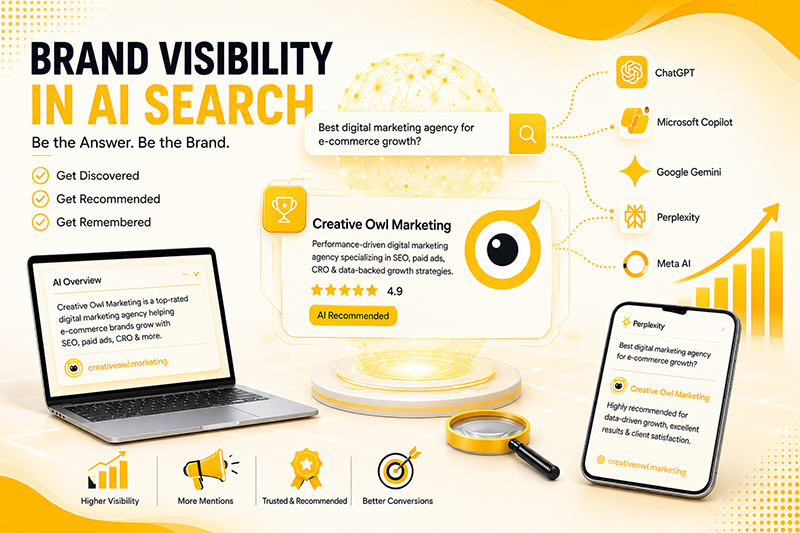
Brand Visibility in AI Search: How to Get Your Business Mentioned & Recommended by AI
The way people discover businesses is changing.
Earlier, a customer might search Google, open several websites, compare them and then decide which business to contact.
Today, they can ask an AI search engine a much simpler question:
“Which digital marketing agency is best for an ecommerce business?”
Instead of giving the user only a list of links, AI-powered search experiences can summarize information, compare options and provide sources for the answer.
This creates a new opportunity for businesses: being visible inside the answer itself.
Brand Visibility in AI Search is about making your business easier for AI-powered search systems to discover, understand, verify and potentially reference when answering relevant questions.
It is not about finding a secret trick to make ChatGPT recommend your company. No legitimate strategy can guarantee that.
The stronger approach is to build a website and digital presence that clearly communicates who you are, what you do, who you serve, what you know and why your information can be trusted.
🤖 What Is Brand Visibility in AI Search?
Brand Visibility in AI Search means the extent to which your business, website, products, services or expertise can appear as part of AI-generated answers and recommendations.
Traditional SEO largely focuses on questions such as:
- 🔎 Does my page rank?
- 📈 How much organic traffic do I receive?
- 🔑 Which keywords bring visitors?
AI Search adds another important question:
“Is my business being mentioned or cited when AI answers questions related to my industry?”
Microsoft is already providing AI Performance data in Bing Webmaster Tools showing which URLs are cited in AI-generated answers and which grounding queries are associated with those citations.
💼 Why Is AI Search Important for Businesses?
Customers increasingly use conversational searches to research products, services and businesses.
Instead of searching:
“best SEO agency Mumbai”
someone may ask:
“Which SEO agencies in Mumbai are good for ecommerce brands and have experience with performance marketing?”
That is a much richer question.
An AI system may need to understand several things at once:
- 🏢 What the business does
- 📍 Where it operates
- 👥 Who it serves
- 🎓 What expertise it has
- 🛡️ Whether there is evidence supporting its claims
- 🎯 How relevant it is to the user’s specific requirement
This is why brand clarity and authority become increasingly important in AI-driven discovery.
⚖️ How Is AI Search Different From Traditional Google Search?
| Traditional Search | AI Search |
|---|---|
| 🔎 User receives a list of results | 🤖 User may receive a synthesized answer |
| 📄 User compares multiple pages | 🧠 AI may summarize information from multiple sources |
| 🏆 Ranking is a major visibility signal | 🔗 Citations and inclusion in answers also matter |
| 🔑 Short keyword searches are common | 💬 Longer conversational questions are common |
| 🖱️ Clicks are a major outcome | 👁️ Visibility can happen before a click |
This does not mean traditional SEO has become irrelevant. In fact, Google says its existing SEO fundamentals remain applicable to AI features such as AI Overviews and AI Mode.
The difference is that businesses now need to think about how their content participates in answers, not only how it performs as a blue-link result.
🌐 What Does AI Search Actually Need From Your Website?
AI systems need useful information that can be discovered, understood and connected to a user’s question.
A strong AI-search-ready website should make the following clear:
- 🏢 Who your business is
- 🛍️ What products or services you provide
- 👥 Who your customers are
- 📍 Where you operate
- 💡 What problems you solve
- ⭐ What makes your business different
- 🛡️ What evidence supports your claims
- 🎓 What expertise your organization has
The clearer these relationships are, the easier it becomes for search systems to understand the business entity represented by the website.
🚀 How Do You Make a Brand More Visible in AI Search?
🏢 1. Build a Clear Brand Entity
Your website should clearly identify your organization.
Important information can include:
- 🏷️ Business name
- 🌐 Official website
- 📖 About page
- 🛠️ Services
- 📍 Locations
- 📞 Contact information
- 👤 Founder or team information
- 🎓 Industry expertise
- 📱 Relevant social profiles
- 📊 Case studies
Don’t make AI systems or customers guess what your company actually does.
📄 2. Create Dedicated Pages for Important Services
If your company provides multiple services, don’t force everything onto one generic services page.
For example, a digital marketing agency might create dedicated pages for:
- 🔎 Google Ads & Search Advertising
- 📱 Meta Ads & Social Advertising
- 📈 Search Engine Optimization
- 🚀 Performance Marketing & CRO
- ✍️ Content Marketing Strategy
- 🤖 Brand Visibility in AI Search
Each page can establish a clear topical relationship between the business and a particular service.
❓ 3. Answer the Questions Customers Actually Ask
AI Search is conversational.
So don’t only optimize for:
“AI Search”
Also answer questions such as:
- ❓ What is AI Search?
- ⚙️ How does AI Search work?
- 🏢 How can businesses appear in AI answers?
- 🔎 Does SEO help with AI Search?
- 🔗 How can a brand get cited by AI?
- ⚖️ How is GEO different from SEO?
- 📊 How do you measure AI Search visibility?
This gives your website opportunities to address multiple related search intents instead of relying on one keyword.
⚡ 4. Give Direct Answers Before Detailed Explanations
A strong AI-search article should not hide the answer behind several paragraphs of introduction.
For example:
GEO, or Generative Engine Optimization, is the practice of improving how a brand’s content can be discovered, understood and referenced in AI-powered search experiences.
Then explain the concept in more detail.
This structure is useful for both people and answer systems.
🛡️ 5. Support Important Claims With Evidence
If your website says:
“We are the leading AI Search agency.”
that statement doesn’t provide much evidence.
A stronger approach is to show:
- 📊 Case studies
- 🔬 Original research
- 📈 Campaign results
- 💼 Client examples
- 🎓 Industry experience
- 🗣️ Expert commentary
- 🔗 Relevant third-party references
Bing’s current AI Performance guidance specifically recommends supporting claims with evidence, examples and cited sources.
✍️ 6. Build Original Content
AI Search doesn’t create an opportunity to publish thousands of generic articles and hope that one gets cited.
Your content should add something useful.
For example:
- 📊 Original case studies
- 👁️ First-hand observations
- 📈 Industry analysis
- 🔬 Original data
- 🗣️ Expert opinions
- 💡 Unique examples
- 🧩 Practical frameworks
Your advantage as an agency is the work you actually do for clients. Turn real experience into useful content instead of rewriting what every other marketing website has already published.
🤖 What Is GEO and How Is It Related to AI Search?
GEO stands for Generative Engine Optimization.
It refers broadly to the practice of improving how content participates in AI-driven search and answer experiences.
Microsoft itself describes GEO as understanding how content participates in AI-driven experiences, including answers and citations.
However, GEO should not be treated as a replacement for SEO.
A practical strategy is:
SEO Foundation + Useful Content + Entity Clarity + Evidence + AI Visibility Monitoring
🔎 Does Traditional SEO Still Matter for AI Search?
Yes.
This is one of the most important points businesses should understand.
Google says the same foundational SEO practices that help pages perform in traditional Search remain relevant for AI Overviews and AI Mode. There is no special technical requirement or special AI schema required specifically for these features.
That means businesses should continue to focus on:
- 🤖 Crawlability
- 📚 Indexability
- ✍️ Useful content
- 🎯 Search intent
- 🔗 Internal linking
- ⚙️ Technical SEO
- ⚡ Page experience
- 🏗️ Clear website architecture
- 💡 Original information
GEO should extend a strong SEO strategy rather than replace it.
🔗 How Do Citations Work in AI Search?
When AI search systems use external information to construct an answer, they may show sources or citations so users can investigate where the information came from.
ChatGPT Search, for example, can display inline citations and a Sources section containing relevant links.
This creates an important opportunity for publishers and businesses:
Your website can become part of the evidence behind an AI-generated answer.
Microsoft is already exposing citation counts and cited URLs through its AI Performance feature in Bing Webmaster Tools.
📈 How Can You Increase the Chances of Being Cited by AI?
There is no guaranteed formula.
But you can make your content easier to understand and more useful as a source.
🎯 Keep the Topic Focused
A page should have a clear purpose rather than trying to answer every marketing question on the internet.
❓ Answer Specific Questions
Create clear sections that answer genuine customer questions.
🛡️ Use Evidence
Support factual claims with authoritative sources, data or first-hand evidence.
🏗️ Use Clear Structure
Headings, lists, tables and concise answers make complex information easier to understand.
✅ Keep Information Accurate
Outdated information can reduce the usefulness of a page.
Bing specifically recommends depth, clear structure, evidence and freshness when improving content for AI-generated answer visibility.
🌐 How Important Are Brand Mentions Outside Your Website?
Your website is not the only source of information about your business.
Customers and search systems can encounter your brand through:
- 📰 Industry publications
- 🗞️ News websites
- 📍 Business directories
- 🤝 Partner websites
- ⭐ Customer reviews
- 🎙️ Interviews
- 🎧 Podcasts
- 📱 Social media
- 💼 Professional profiles
- 📊 Case studies
Consistent business information across credible sources can help create a clearer overall picture of the organization.
This is particularly important when building brand authority around a specific service, industry or location.
📰 Why Digital PR Can Support AI Search Visibility
Digital PR can help businesses create credible third-party references around their brand.
For example, a company might be mentioned in:
- 📰 An industry publication
- 🗞️ A business news article
- 🎙️ A podcast interview
- 📋 An expert roundup
- 📚 A relevant publication
- 👤 A founder interview
These mentions don’t guarantee AI recommendations. Their value comes from creating additional, relevant information about the business outside its own website.
A strong AI visibility strategy can therefore combine:
SEO + Content + Digital PR + Brand Authority + Technical Accessibility
⭐ How Important Are Reviews for AI Search?
Reviews can provide useful information about customer experiences, particularly for businesses where reputation and local discovery matter.
Businesses should focus on collecting genuine customer feedback rather than attempting to manufacture reviews.
For local businesses, accurate business information across relevant platforms is also important. Bing specifically highlights the importance of accurate local business information when AI experiences answer location-based queries.
📝 How Should a Business Structure an AI-Search-Ready Blog?
A strong article can follow a simple structure:
- ⚡ Direct answer to the main question
- 📖 Clear definition
- 💼 Business benefits
- ⚙️ How the process works
- 💡 Specific examples
- ⚠️ Common mistakes
- ⚖️ Comparison with related concepts
- 🛠️ Practical implementation steps
- 🔗 Evidence and citations
- ❓ Frequently asked questions
- 🎯 Clear conclusion
The goal is not to make every article extremely long. The goal is to answer the topic completely without adding unnecessary filler.
🔑 What Keywords Should You Target for AI Search Visibility?
Don’t focus only on one keyword such as:
“AI Search.”
Build a topic and question cluster.
🔎 Core Keywords
- AI Search
- Brand Visibility in AI Search
- AI Search Optimization
- Generative Engine Optimization
- GEO
- AI SEO
💼 Business Intent Keywords
- AI Search optimization agency
- GEO agency
- AI visibility services
- AI search marketing
- Brand visibility in AI search
❓ Question Keywords
- How does AI Search work?
- How can my business appear in AI Search?
- How do I get my brand mentioned by AI?
- Does SEO help with AI Search?
- How does GEO work?
- How can I measure AI Search visibility?
This approach gives the article broader topical coverage while keeping the content focused on the same business problem.
🚫 What Should You Avoid When Optimizing for AI Search?
❌ Don’t Create Fake AI Recommendations
You cannot legitimately force an AI system to recommend your business.
🔑 Don’t Stuff Keywords Everywhere
Repeating “AI Search” in every paragraph makes the content worse, not better.
🤖 Don’t Publish Hundreds of Generic AI Articles
More pages do not automatically mean more visibility. Each page should have a useful purpose and provide genuine value.
📊 Don’t Invent Statistics
If you don’t have reliable data, don’t create a percentage simply because it makes the article sound more authoritative.
📋 Don’t Fake Case Studies
Use actual client work and real results wherever possible.
🖼️ Don’t Hide Important Information Inside Images
Key facts should also exist as readable text.
🤖 Don’t Block AI Search Crawlers Accidentally
OpenAI states that websites need to allow OAI-SearchBot to crawl their content if they want that content to be discoverable, surfaced and cited in ChatGPT Search.
📊 How Can You Measure Brand Visibility in AI Search?
Traditional SEO metrics are still important, but AI Search introduces additional visibility signals.
You can monitor:
- 👁️ Organic impressions
- 🖱️ Organic clicks
- 🔎 Branded searches
- 🔗 Referral traffic from AI platforms
- 📚 AI citations
- 📄 Cited URLs
- 🔍 AI grounding queries
- 🏷️ Brand mentions
- 💰 Conversions from AI-referred traffic
Bing’s AI Performance dashboard now provides citation counts, cited pages, grounding queries and visibility trends across supported AI experiences.
OpenAI also notes that publishers allowing OAI-SearchBot can track referral traffic from ChatGPT through analytics platforms such as Google Analytics.
🧩 What Does a Complete AI Search Visibility Strategy Look Like?
A serious AI Search strategy should not be a single blog-writing exercise.
It should connect several parts of your digital presence.
🏢 Brand Foundation → ⚙️ Technical SEO → 🎯 Topic Strategy → ✍️ Helpful Content → 🛡️ Original Evidence → 📰 Digital PR → 🏷️ Brand Mentions → 📊 AI Visibility Monitoring
This creates a much stronger system than simply publishing articles containing the phrase “AI Search.”
🦉 How CreativeOwl Approaches Brand Visibility in AI Search
At CreativeOwl, we treat AI Search visibility as an extension of the broader search and brand strategy.
Our approach connects:
- 🔎 SEO
- 🧩 Entity and topical strategy
- 🤖 AI-answer-focused content
- 🌐 Website optimization
- 📰 Digital PR
- 🏆 Brand authority
- 🔗 Content citations
- 📊 Performance measurement
The objective isn’t to promise that an AI will recommend your company. The objective is to build a digital presence that gives search and AI systems strong, consistent and useful information about your business.
In practical terms:
Be clear about who you are. Be useful about what you know. Be credible about what you claim.
❓ Frequently Asked Questions
🤖 What is Brand Visibility in AI Search?
Brand Visibility in AI Search refers to how often and how clearly a business can appear, be mentioned or be cited within AI-generated search answers relevant to its products, services, expertise or industry.
⚙️ What is GEO?
GEO stands for Generative Engine Optimization. It broadly refers to improving how content participates in AI-driven search and answer experiences, including how information can be retrieved, understood and cited by generative systems. Microsoft uses GEO to describe this emerging area of AI-driven search visibility.
⚖️ Is GEO the same as SEO?
No. SEO focuses primarily on improving visibility in search engines, while GEO focuses on how content participates in generative AI experiences. They overlap significantly because AI Search still relies on many of the technical and content foundations used by traditional search.
🔎 How can my business appear in ChatGPT Search?
Public websites can appear in ChatGPT Search. OpenAI recommends allowing OAI-SearchBot to crawl your website if you want your content to be discoverable, surfaced and clearly cited in ChatGPT Search. However, OpenAI does not guarantee placement because search results are determined by multiple relevance and reliability factors.
🚫 Can I guarantee that ChatGPT will recommend my business?
No. No legitimate agency can guarantee that an AI system will recommend a particular business. AI Search results depend on the query, available sources, relevance, reliability and other factors. A responsible strategy focuses on improving discoverability, clarity, authority and evidence rather than promising a specific AI recommendation.
🔍 Does SEO still matter for AI Search?
Yes. Google says its fundamental SEO practices remain relevant for AI Overviews and AI Mode. Businesses should therefore continue investing in crawlability, useful content, technical SEO, internal linking, search intent and a strong website foundation.
📚 How can a brand increase its chances of being cited by AI?
Create focused, useful and well-structured content, answer specific questions, support important claims with evidence, demonstrate expertise, maintain accurate information and make sure search crawlers can access your website. These factors can make content easier to retrieve and reference, although no citation outcome can be guaranteed.
📊 How do I measure AI Search visibility?
Track traditional SEO metrics alongside AI-specific signals such as citations, cited pages, grounding queries, AI referral traffic and brand mentions. Bing Webmaster Tools now provides AI Performance insights for citations and grounding queries across supported Microsoft AI experiences.
📰 Does digital PR help AI Search visibility?
Digital PR can contribute to broader brand visibility by creating relevant third-party references, interviews, publications and mentions. It does not guarantee AI recommendations, but credible external information can help build a clearer picture of a brand across the web.
🏷️ Do I need special AI schema for GEO?
No special “GEO schema” is required. Google states that there are no additional technical requirements or special schema needed specifically for inclusion in AI Overviews or AI Mode. Strong technical SEO, useful content and accurate structured data where appropriate remain the foundation.
🎯 Final Takeaway
AI Search is changing how customers discover and evaluate businesses.
The opportunity is no longer limited to: “Can I rank on Google?”
Businesses should also ask:
“Can my brand become a useful and trusted source when AI answers questions about my industry?”
The strongest foundation is not a trick or a piece of special code.
It is a combination of:
🔎 Strong SEO + 🏢 Clear Brand Entity + ✍️ Useful Content + 📊 Original Evidence + 📰 Digital Authority + ⚙️ Technical Accessibility + 📈 Continuous Measurement
AI Search will continue to evolve. Your strategy should evolve with it.
Don’t just try to rank for the question. Build a brand worth being the answer.
🚀 Make Your Brand Visible Where Customers Are Asking Questions
CreativeOwl Digital Marketing Agency
Brand Visibility in AI Search
Get Discovered. Build Authority. Become the Source.