


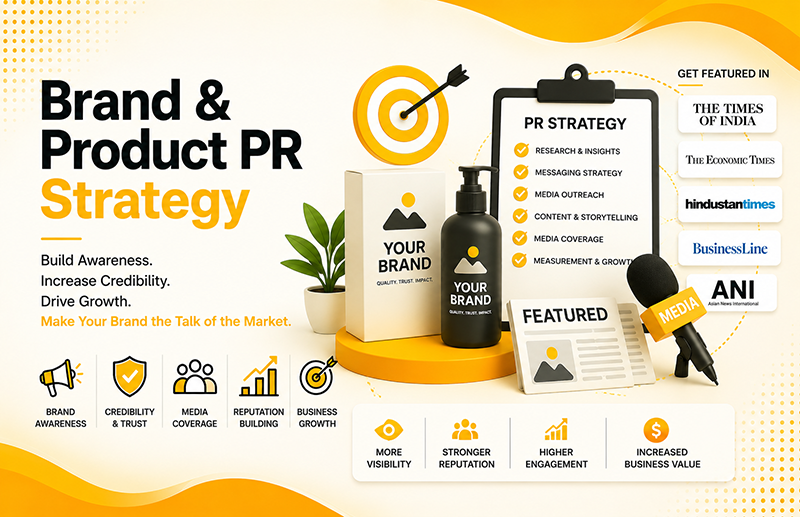
Brand & Product PR Strategy: How Businesses Build Visibility, Trust and Demand
A good product can fail to get attention if nobody knows about it. A strong brand can also struggle to grow if its story is not reaching the right audience.
Brand & Product PR Strategy helps businesses build public visibility around their brand, products, launches, achievements and stories through relevant media, content and communication opportunities.
PR is not simply about getting a logo or product mentioned in the news. The bigger objective is to shape how people discover, understand and remember the brand.
In simple terms:
🏢 Strong Brand Story + 🛍️ Valuable Product + 📰 Relevant PR + 🎯 Right Audience + ⭐ Credibility = Stronger Brand Visibility
This guide explains what brand and product PR means, why businesses need it, how to launch a product through PR, how brand positioning works, which PR activities can be used and how businesses can measure the impact of their PR strategy.
🏢 What Is Brand PR?
Brand PR is the process of building public awareness and reputation around a company, brand or organization through strategic communication and relevant media opportunities.
Brand PR can focus on:
- 🏢 Company identity
- 💡 Brand story
- 👤 Founder and leadership
- 🎯 Brand positioning
- 🏆 Achievements
- 🤝 Partnerships
- 🌍 Business expansion
- 💡 Industry expertise
- 📊 Original insights
The objective is to create a stronger and more recognizable public presence over time.
🛍️ What Is Product PR?
Product PR focuses on creating awareness around a specific product, service, launch, feature or customer benefit.
It can be used for:
- 🚀 New product launches
- 🆕 New product versions
- 💡 Product innovations
- 🎁 New collections
- 🌍 New market launches
- 📊 Product research
- 🏆 Product awards
- ⭐ Customer-focused product stories
Product PR gives businesses an opportunity to explain not only what the product is, but also why it matters to customers.
⚖️ What Is the Difference Between Brand PR and Product PR?
| 🏢 Brand PR | 🛍️ Product PR |
|---|---|
| Focuses on the overall brand | Focuses on a specific product or service |
| Builds long-term reputation | Supports product awareness and demand |
| Can focus on founders and company stories | Can focus on product benefits and launches |
| Supports brand positioning | Supports product positioning |
| Usually has a longer-term objective | Can be connected to a specific launch or campaign |
The strongest PR strategies often use both together.
💼 Why Do Businesses Need a Brand & Product PR Strategy?
Advertising can help businesses buy attention, but PR can help create broader public visibility and third-party conversations around a brand or product.
A well-planned PR strategy can help:
- 👀 Increase brand awareness
- ⭐ Strengthen credibility
- 📰 Generate media visibility
- 🎯 Reach relevant audiences
- 🛍️ Support product launches
- 👤 Build founder visibility
- 🤝 Support partnerships
- 🌍 Expand into new markets
- 💡 Establish industry expertise
PR is most effective when it supports a wider marketing and business strategy.
🎯 What Is Brand Positioning in PR?
Brand positioning is about establishing how you want your business to be understood compared with other options in the market.
For example, a company might want to be known for:
- 💡 Innovation
- ⭐ Premium quality
- 💰 Affordability
- 🌱 Sustainability
- 🧠 Expertise
- 🎯 Specialization
- 🤝 Customer experience
PR should reinforce the positioning instead of creating disconnected stories.
If you want to be known for expertise, your PR should demonstrate expertise — not just repeatedly say that you are an expert.
🧲 What Makes a Product Interesting to the Media?
Simply launching a product does not automatically make it newsworthy.
A stronger product PR story explains why the launch matters.
Potential angles include:
- 💡 A new solution to a meaningful problem
- 🚀 A significant innovation
- 🎯 A product designed for an underserved audience
- 🌍 Entry into a new market
- 📊 Original research behind the product
- 🤝 A significant partnership
- 🏆 An important product achievement
- 🌱 A meaningful sustainability initiative
The story should focus on relevance rather than simply describing the product’s features.
🚀 How Do You Launch a Product With PR?
A product launch PR campaign should ideally begin before the launch date.
A practical structure can look like:
🧠 Strategy → 📰 Story → 📩 Media Outreach → 📢 Launch → 🗞️ Coverage → 📱 Amplification → 📊 Measurement
🧠 1. Define the Product Story
Explain what the product solves and why the launch matters.
🎯 2. Identify the Audience
Understand who needs to hear about the product.
📰 3. Identify Relevant Media
Find publications and journalists whose audiences match the product.
📩 4. Prepare Media Outreach
Develop concise and relevant pitches for appropriate media contacts.
🚀 5. Coordinate the Launch
Align the PR announcement with the actual product launch.
📢 6. Amplify the Story
Share relevant coverage across owned marketing channels.
📊 7. Measure the Results
Track visibility, traffic, engagement, enquiries and other relevant outcomes.
📰 What PR Channels Can Businesses Use?
A brand and product PR strategy can use multiple communication channels depending on the objective.
- 📰 Online media coverage
- 📢 Press release distribution
- 🎤 Founder interviews
- 👤 Expert commentary
- 🎙️ Podcasts
- 💼 Industry publications
- 📱 Social media
- 📝 Brand-owned content
- 🎥 Product videos
- 📊 Original research
The goal is not to use every channel. Choose channels based on where your target audience and relevant media actually are.
👤 Why Should Founders Be Part of Brand PR?
People often connect with people more easily than corporate logos.
Founder PR can help communicate:
- 🧠 Expertise
- 💡 Business vision
- 🚀 Entrepreneurial journey
- 📈 Industry insights
- 🎯 Company mission
- 🏆 Business achievements
A founder can become an important part of the brand story, particularly when the company’s origin or expertise is closely connected to the founder.
📊 How Can Original Data Strengthen Product PR?
Original data can give journalists a stronger reason to discuss a company or product.
Examples include:
- 📊 Customer research
- 📈 Industry surveys
- 🔎 Market analysis
- 🧪 Product usage insights
- 📋 Consumer studies
- 💡 Original industry observations
Instead of saying:
“Our product is changing the market.”
a business can provide evidence that helps explain what is actually changing.
⭐ How Does PR Build Trust for a New Brand?
New brands often have a visibility problem. Potential customers may ask:
- ❓ Who are they?
- ❓ Can I trust them?
- ❓ What makes them different?
- ❓ Are other people talking about them?
- ❓ Why should I choose them?
Consistent brand communication and relevant third-party coverage can provide additional context while customers research the business.
Trust is built through multiple signals over time — not through one media article.
🔎 Can Brand & Product PR Help SEO?
PR can support broader online visibility by creating opportunities for brand mentions, media coverage, referral traffic and discovery.
A strong PR strategy can work alongside SEO:
📰 PR Coverage → 👀 Brand Discovery → 🔎 Brand Search → 🌐 Website Visit → 🧠 Research → 🎯 Potential Conversion
However, businesses should not treat PR as a guaranteed backlink-building technique. The primary value of PR is communication, visibility, credibility and relevant audience exposure.
🤖 Can Brand PR Help AI Search Visibility?
PR can contribute to a brand’s broader digital footprint by creating publicly available information about the company, founders, products and expertise.
Relevant third-party coverage may provide additional context about a business across the web.
However, no PR campaign can guarantee that an AI search system will mention, recommend or cite a particular brand.
For a stronger overall AI-search presence, businesses should combine PR with:
- 🌐 Clear website information
- 📝 Helpful expert content
- 👤 Strong founder information
- 📊 Original data
- ⭐ Genuine third-party coverage
- 🏢 Consistent business information
- 🔗 Relevant internal and external references
📱 How Can Social Media Support Product PR?
PR coverage should not disappear after publication.
Businesses can turn a product story into:
- 📱 Instagram posts
- 🎥 Reels
- ▶️ YouTube videos
- 💼 LinkedIn posts
- 📧 Email content
- 📊 Infographics
- 📝 Blog articles
This creates multiple opportunities for the audience to encounter the same important story.
🛍️ How Can Ecommerce Brands Use Product PR?
Ecommerce brands can use product PR to create awareness around new products, collections, innovations and customer-focused developments.
Useful PR angles can include:
- 🆕 New product launch
- 🎨 New collection
- 💡 Product innovation
- 📊 Consumer trends
- 🌱 Sustainability story
- 🏆 Product recognition
- 👤 Founder story
Product PR can work alongside paid advertising, influencer marketing, SEO, social media and content marketing.
💼 How Can B2B Companies Use Product PR?
B2B products often require more explanation because the buying decision can involve multiple people and a longer evaluation process.
Useful PR angles include:
- 💡 Technology innovation
- 📊 Original research
- 🤝 Strategic partnerships
- 🌍 Market expansion
- 🚀 Product launches
- 🧠 Industry expertise
- 🏆 Business milestones
Thought leadership and expert commentary can be particularly useful for establishing the people behind the business as credible industry voices.
💰 How Much Does a Brand & Product PR Campaign Cost?
There is no single fixed cost for a PR campaign.
Pricing can depend on:
- 🧠 Strategy requirements
- 📝 PR content creation
- 📰 Media targets
- 📢 Press release distribution
- 🤝 Media outreach
- 👤 Founder PR
- 📸 Creative assets
- 🌍 Geographic coverage
- 📊 Reporting
- ⏳ Campaign duration
Businesses should evaluate what is actually included in a PR package rather than judging an agency only by the number of publications promised.
📊 How Should You Measure Brand & Product PR?
PR should be measured according to the campaign objective.
Possible metrics include:
- 📰 Relevant media placements
- 🎯 Publication relevance
- 👀 Audience reach
- 🌍 Geographic coverage
- 🔎 Brand mentions
- 🌐 Referral traffic
- 📈 Brand search activity
- 📱 Social engagement
- 📞 Enquiries
- 🛒 Product interest
- 🤝 Business opportunities
For product launches, businesses can also monitor traffic and conversions around the launch period where reliable tracking is available.
⚠️ What Are the Most Common Brand & Product PR Mistakes?
❌ Treating PR Like Advertising
A media story should provide information or a meaningful angle rather than simply repeat promotional copy.
📰 Launching Without a Story
A new product is not automatically newsworthy. The PR campaign needs to explain why the launch matters.
🎯 Targeting the Wrong Media
A publication is valuable only when its audience or subject matter is relevant to your story.
💬 Making Every Quote Promotional
Executive quotes should add insight, context or perspective.
🔗 Focusing Only on Backlinks
PR should not be reduced to link building.
📢 Promising Guaranteed Editorial Coverage
Independent editorial decisions are controlled by publishers and journalists.
📊 Measuring Only Article Count
The number of placements does not tell the whole story. Relevance and business impact matter.
🧠 Changing the Brand Message Every Month
Consistent positioning makes it easier for audiences to understand what the brand stands for.
🛠️ How to Build a Brand & Product PR Strategy
- 🎯 Define the Brand Objective
- 👥 Identify the Target Audience
- 🏢 Define Brand Positioning
- 🛍️ Identify Product Stories
- 📰 Find Newsworthy Angles
- 🧑💼 Identify Relevant Journalists and Publications
- 📝 Prepare Press and Media Content
- 📸 Prepare Images, Videos and Supporting Assets
- 📩 Conduct Targeted Media Outreach
- 📢 Distribute Press Releases When Appropriate
- 🗞️ Track Published Coverage
- 📱 Amplify Coverage Across Owned Channels
- 📊 Measure Visibility and Business Outcomes
- 🔄 Refine the PR Strategy Based on Results
🧩 What Should a Long-Term PR Strategy Include?
A strong PR strategy should not depend on one product launch.
Businesses can create multiple story opportunities throughout the year.
For example:
- 🚀 Q1 — Product launch
- 📊 Q2 — Industry research
- 👤 Q3 — Founder thought leadership
- 🏆 Q4 — Business milestone
This creates a continuing narrative around the brand.
The goal is to build recognition gradually rather than trying to create all visibility from one campaign.
🤖 How Can AI Help With PR Strategy?
AI can assist with parts of the PR workflow, including:
- 💡 Story-angle brainstorming
- 📝 Drafting content variations
- 🔎 Research assistance
- 📚 Topic organization
- 🎯 Audience analysis
- 📝 Content repurposing
- 📊 Coverage analysis
However, PR still requires human judgement.
Journalists need relevant stories, credible information and useful perspectives — not mass-produced generic pitches.
AI can make PR workflows faster, but it cannot manufacture genuine newsworthiness.
🦉 How CreativeOwl Approaches Brand & Product PR
At CreativeOwl, we don’t start a PR campaign by asking how many publications we can reach.
We start with the more important question:
“What should people remember about this brand or product?”
Our approach connects:
🏢 Brand Positioning → 🛍️ Product Story → 📰 PR Angle → 🎯 Relevant Media → 📢 Distribution & Outreach → 🗞️ Coverage → ⭐ Credibility → 🌐 Brand Visibility → 📊 Business Opportunity
Depending on the campaign, this can include brand PR, product PR, online media coverage, press release distribution, founder PR and supporting digital marketing activities.
The objective is not to create publicity for publicity’s sake. It is to build a consistent public story around the brand and give the right audience a reason to pay attention.
❓ Frequently Asked Questions
🏢 What is Brand PR?
Brand PR is the process of building public awareness, reputation and positioning around a company or brand through strategic communication and relevant media opportunities.
🛍️ What is Product PR?
Product PR focuses on creating awareness around a specific product, service, launch, innovation or customer-focused development.
⚖️ What is the difference between Brand PR and Product PR?
Brand PR focuses on the overall identity and reputation of a business, while Product PR focuses on a particular product or service. A strong strategy can use both together.
🚀 How can PR help a product launch?
PR can help communicate a product’s story to relevant media and audiences, create awareness and support broader launch marketing. It does not guarantee sales or editorial coverage.
📰 What makes a product launch newsworthy?
A launch becomes more interesting when it has a meaningful story, such as a genuine innovation, important customer problem, new market development, original research or significant partnership.
⭐ Can Brand PR improve credibility?
Relevant third-party coverage can contribute to credibility by giving customers additional information about the business. Credibility is built over time through multiple trustworthy signals.
🔎 Does Brand PR help SEO?
PR can support brand discovery, media mentions and referral traffic. However, PR should not be treated simply as a method of acquiring backlinks or guaranteeing search rankings.
🤖 Can Product PR help AI Search visibility?
PR can contribute to a broader digital footprint by creating publicly available information about a brand, product and expertise. However, no PR campaign can guarantee that an AI search system will mention or cite a business.
👤 Should founders be included in a brand PR strategy?
They can be, particularly when the founder has relevant expertise, a compelling business story or useful industry insights that add value to the media audience.
💰 How much does Brand & Product PR cost?
Costs vary according to strategy, media targets, distribution, outreach, content creation, geographic coverage, creative assets and campaign duration.
🎯 How do I choose the right media for my PR campaign?
Choose publications based on audience relevance, industry relevance, geographic relevance, editorial focus and credibility rather than simply selecting the largest possible number of outlets.
📊 How should I measure PR success?
Businesses can measure relevant media placements, publication quality, audience reach, brand mentions, referral traffic, engagement, enquiries, product interest and other business outcomes.
📢 Does paying for PR guarantee editorial coverage?
No. A paid PR service may provide distribution, outreach or campaign support, but independent editorial decisions remain with the publication or journalist.
🔄 How often should a brand run PR campaigns?
There is no universal frequency. Businesses should create PR campaigns around genuinely relevant stories, product developments, expertise, research, milestones and other meaningful opportunities.
🛒 Can Product PR increase sales?
It can contribute to awareness and customer discovery, but PR alone does not guarantee sales. Product quality, pricing, offer, audience, website and overall marketing strategy also influence conversions.
🧠 Is PR useful for a new brand?
Yes. PR can help a new brand introduce its story, founders, products and expertise to relevant audiences. The strongest results come from combining PR with a clear brand position and broader marketing strategy.
🎯 Final Takeaway
Brand & Product PR is not simply about getting your company or product mentioned in an online publication.
It is about creating a consistent public story that helps the right audience understand what your brand stands for and why your product matters.
A strong strategy connects:
🏢 Brand Positioning → 🛍️ Product Value → 📰 Newsworthy Story → 🎯 Relevant Media → 🗞️ Third-Party Coverage → ⭐ Credibility → 🌐 Brand Visibility → 📈 Business Growth
Don’t chase publicity just to increase the number of articles about your business.
Build a story people remember, put it in front of the right audience and make your PR part of a larger growth strategy.
🚀 Build Visibility Around Your Brand & Product
CreativeOwl Digital Marketing Agency
Brand & Product PR Strategy
Build the Story. Create Visibility. Make Your Brand Remembered.